

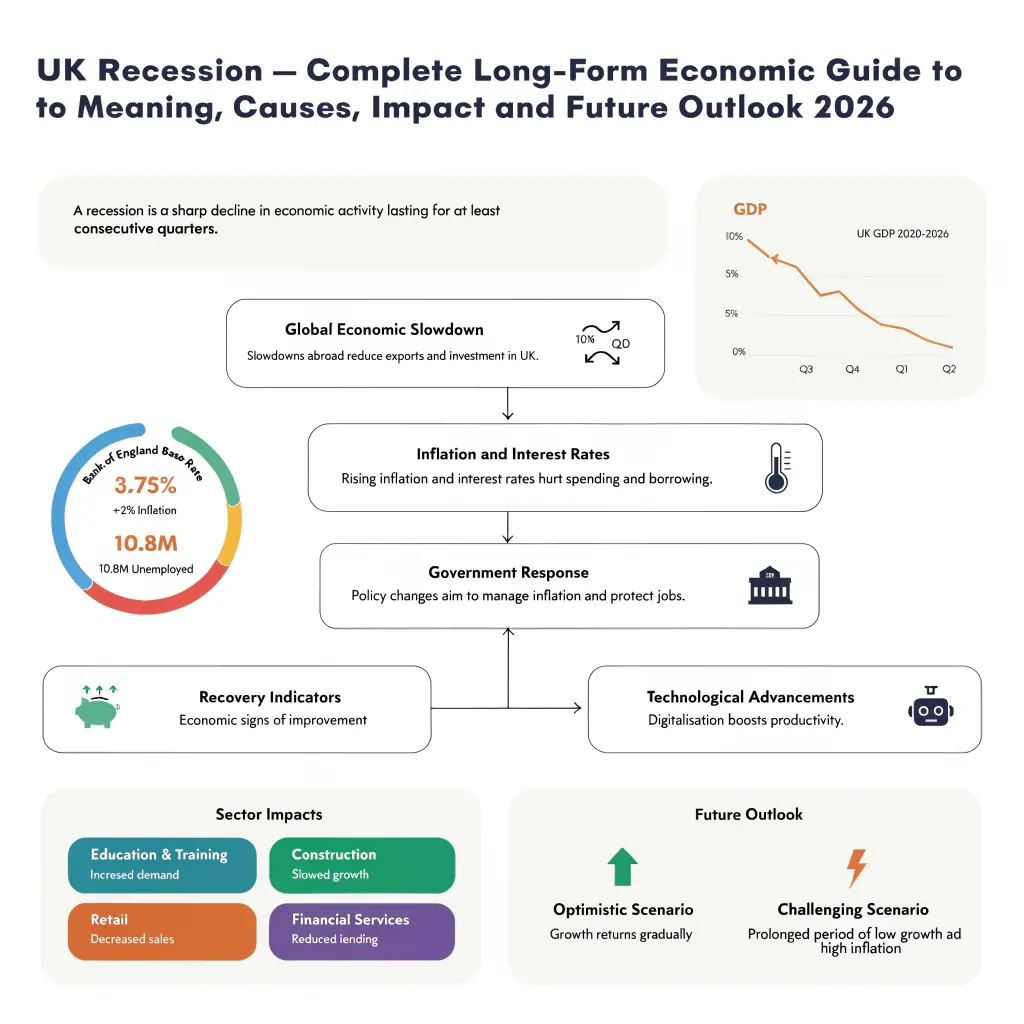
The UK economy in 2026 is showing signs of slow and fragile growth, raising concerns among economists and policymakers about future stability. While the country is not officially in a recession, rising living costs, high interest rates, and weak productivity are creating financial pressure on households and businesses. Consumer spending remains cautious as people adjust to higher prices for essential goods and services. At the same time, global uncertainty continues to affect trade and investment. This combination of factors has increased discussions about the possibility of a UK recession, making economic monitoring and planning more important than ever.
What is UK Recession? (Meaning in Simple and Detailed Form)
A recession is an economic condition where a country experiences a decline in economic activity for two consecutive quarters, based on Gross Domestic Product (GDP). In simple terms, it means that the economy is shrinking instead of growing. When this happens, businesses produce fewer goods and services, employment opportunities decrease, and overall financial activity slows down across the country.
A UK recession specifically refers to this situation occurring within the United Kingdom’s economy. It affects not just large industries but also everyday life for individuals. During such periods, companies may reduce hiring, delay investments, or even cut jobs due to lower demand. At the same time, households often reduce spending because of rising financial pressure or uncertainty about income. This creates a cycle where reduced spending leads to lower business revenue, which further weakens economic activity.
It is important to understand that recessions are a natural part of economic cycles. Every economy goes through phases of expansion and contraction. However, the impact of each downturn depends on its cause, duration, and severity. Some recessions are short and mild, while others can be deeper and longer-lasting depending on economic conditions.
Current UK Economic Situation in 2026
In 2026, the UK economy is in a low-growth phase, meaning it is still expanding but at a very slow rate. This slow pace of growth is one of the main reasons economists continue to discuss the possibility of a UK recession in the future. Although inflation has come down compared to previous highs, essential living costs such as rent, food, transport, and energy remain relatively high. This continues to place pressure on household budgets and reduces disposable income.
Consumer confidence remains weak because many people are still adjusting to higher prices and financial uncertainty. When households feel uncertain about the future, they tend to reduce spending, which further slows down economic activity. Businesses are also cautious about expansion because borrowing costs remain high and demand is unpredictable. This creates an environment where both consumption and investment remain limited.
The performance of different sectors is also uneven. Some industries, especially services and technology, are relatively stable, while others such as retail, construction, and manufacturing are experiencing slower demand. This imbalance makes the overall economic picture more fragile and uncertain.
Main Causes Behind Economic Slowdown and Recession Risk
The risk of a UK recession is not caused by a single issue but by a combination of economic pressures working together. One of the most significant factors is the high cost of living. When prices for essential goods and services remain high, households have less money available for non-essential spending. This reduction in consumer demand directly affects business revenue and slows economic growth.
Energy costs also remain a major concern. Even when global energy markets stabilize, domestic prices remain elevated for households and industries. This increases operating costs for businesses, especially those that rely heavily on energy. As a result, profit margins shrink, and companies become more cautious about investment and expansion.
Another major factor is high interest rates. Borrowing money has become more expensive for both consumers and businesses. This discourages spending on big purchases such as homes, cars, and business expansion projects. At the same time, weak productivity growth limits the long-term growth potential of the economy. When productivity does not improve, it becomes harder for the economy to grow sustainably. Combined with global uncertainty, these factors increase the risk of economic slowdown.
How Economic Slowdown Affects People and Businesses
When economic conditions weaken, the impact is felt across all levels of society. For households, the most immediate effect is financial pressure. Rising living costs combined with slow wage growth reduce purchasing power, making it harder to manage everyday expenses. As a result, families often reduce spending on non-essential items such as entertainment, travel, and luxury goods.
For businesses, slower economic activity leads to reduced sales and lower profits. Companies may respond by cutting costs, delaying investment, or reducing staff. Small and medium-sized businesses are particularly vulnerable because they have limited financial reserves to survive long periods of weak demand. This can lead to closures or reduced operations in some cases.
The government also faces challenges during such periods. Lower business activity means reduced tax revenue, while demand for public support programs may increase. This creates pressure on public finances and limits flexibility in economic policy decisions.
Historical Context of UK Economic Downturns
The United Kingdom has experienced several economic downturns in recent history, each caused by different factors but resulting in similar effects. The 2008 financial crisis was triggered by global banking instability and led to a deep recession across many countries, including the UK. The 2020 downturn, on the other hand, was caused by the COVID-19 pandemic, which disrupted global supply chains and economic activity.
In both cases, government intervention played a critical role in stabilizing the economy. Monetary policy changes, fiscal support packages, and emergency financial measures helped reduce the severity of the downturns and support recovery. These examples show that while recessions can be severe, timely policy responses can significantly reduce their long-term impact.
Another important lesson from history is that confidence plays a major role in recovery. When businesses and consumers regain confidence, spending and investment increase, helping the economy return to growth more quickly.
Economic Indicators and Warning Signs
Economists use several indicators to assess whether an economy is moving toward a slowdown. In the current environment, GDP growth remains weak, showing limited expansion in overall economic activity. Inflation has improved compared to previous peaks but still affects household budgets and business costs.
Interest rates remain relatively high, which continues to influence borrowing decisions across the economy. This affects both consumer spending and business investment. At the same time, consumer behavior reflects caution, with many households adjusting their budgets due to financial pressure.
Business investment also remains slow as companies wait for more stable economic conditions before making long-term commitments. These combined indicators suggest that while the economy is not officially in recession, it remains vulnerable to external shocks.
Future Economic Outlook of the UK
The future direction of the UK economy depends on several important factors, including inflation control, interest rate changes, global trade stability, and domestic investment growth. If inflation continues to stabilize and borrowing costs gradually decrease, economic conditions may improve over time.
However, global uncertainty and weak productivity remain significant risks. Economists describe the current situation as low growth with high uncertainty, meaning the economy is stable but fragile. This makes it sensitive to external shocks such as energy price increases or global financial disruptions.
Long-term economic improvement will depend on stronger productivity, increased investment, and innovation-driven growth. Without these structural improvements, the economy may continue to experience slow growth even if a full downturn is avoided.
(FAQs)
1. What is a UK recession?
A recession is an economic situation where the UK economy shrinks for two consecutive quarters, based on GDP. It usually leads to reduced business activity, lower spending, and weaker job growth.
2. Is the UK currently in a recession?
No, the UK is not officially in a recession. However, slow economic growth and high living costs have increased concerns about future risks.
3. What causes a recession in the UK?
A recession in the UK can be caused by high inflation, rising interest rates, weak consumer spending, global uncertainty, and low business investment.
4. How does a recession affect jobs?
A recession can lead to job losses, hiring freezes, and slower wage growth because companies reduce costs when demand falls.
5. How does it affect everyday life?
People may face higher financial pressure, reduced purchasing power, and difficulty managing essential expenses during economic slowdowns.
Conclusion
In conclusion, the UK economy in 2026 remains in a delicate position, with slow growth, persistent cost pressures, and global uncertainty shaping its overall outlook. Although the country is not officially in a recession, several warning signs indicate that economic stability is still fragile. Households continue to face higher living costs, while businesses remain cautious about investment and expansion. The risk of a UK recession depends largely on how effectively inflation is controlled, interest rates are managed, and productivity improves in the coming years. With the right economic policies and stable global conditions, the UK can avoid a deeper downturn and return to stronger, more sustainable growth.
