


“Growing up British Australian once felt ordinary. Today, amid the rise of Reform UK and One Nation, that identity feels increasingly politicised. All I can say is that I definitely was not discussing British-Australian politics over Mother’s Day lunch last year.” – Jesse Maslen, dual citizen
There is an estimated 250,000 British-Australian dual citizens meaning having British or Australian parents is nothing out of the ordinary. Nigel Farage’s right-wing party Reform UK achieved major gains in local council seats across England, Scotland and Wales. Creating overwhelming pressure on the Labour cabinet for Prime Minister Keir Starmer to resign. In Australia’s populist right political party, Pauline Hanson’s One Nation acquired a landslide victory in Farrer’s constituency located in rural New South Wales the day after. Transforming what were once rather small parties to forces to be reckoned with, showing a parallel political shift for Britain and Australia, where debates regarding immigration, housing affordability, and national identity are dominating political discourse. So, where do British-Australian voters fit into all this?
The world’s longest-running centre-right political movement, the Conservative Party, is now polling fourth place across the United Kingdom, like the decline of Australia’s centre-right coalition, the Liberal Party. Unlike One Nation and Reform UK surging in popularity, with their similar values to Donald Trump’s Republican Party in the United States. Trump shifting the Overton window and failure of the centre-right, reveals why people are moving further down the political spectrum.
Critics dismiss these movements, despite them capturing the attention of Gen Z voters. It is reported that 21% of Gen Z women and 26% of Gen Z men intend to vote for Reform UK in next general election in contrast One Nation being quite popular with millennials including dual-citizen voters.
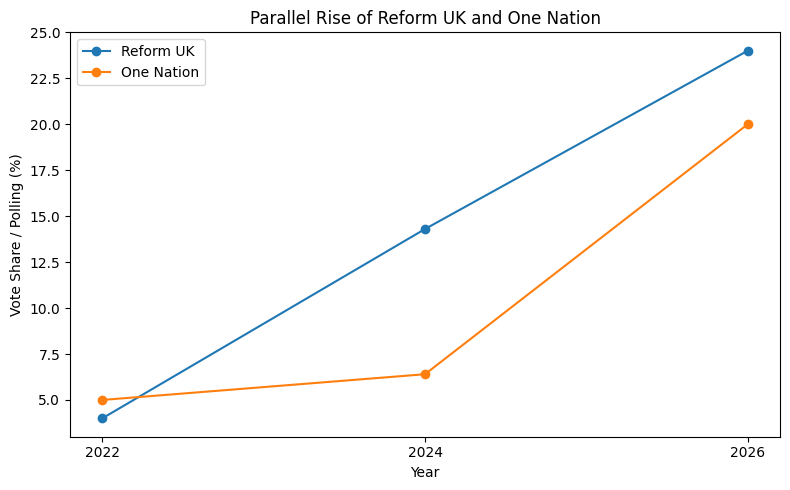
Source: The Economist & The Politico
“When I hear something Canberra, I feel like its echoing what happened in the UK the day before, I am honestly not surprised anymore” – Jesse Maslen, dual citizen
Rhetoric such as increased immigration, cost-of-living and housing affordability are dominating in both Parliaments. Specifically in Britain, as Farage’s popularity is rising as he touts his “Vote Reform: Get Starmer Out” mantra; conflating the pressure the NHS faces with asylum seekers crossing the English Channel. Reform UK’s proposed major policy, being ending mass immigration, mirrors what One Nation aims to do for Australia. Politicians, such as Farage and Hanson, have centred their campaign on public concerns; presenting immigration as the root cause of economic instability for both countries. Despite party leaders’ strict proposals for immigration, most voters want it to be more regulated, as it has benefited both economies.
However, critics argue that there are hidden tax agendas from both parties, which receive less public attention. Hanson’s growing relationship with the likes of Gina Rinehart, and other mining billionaires, corroborates Australian PM Anthony Albanese’s quip that “her tax policies will favour major businesses” similar to Reform UK policies that will benefit the top 10%.
With social media, speech delivered by Farage claiming he will “use Trump like mass deportation tactics” circulates Tik Tok in Australia and the UK quickly. Right-wing Facebook groups are also posting, “Australia now has immigration problems just like in the UK”. However, according to The Australian National University, “Claims of out-of-control immigration in Australia are false”. These claims have played a role in sparking political demonstrations all over the UK and Australia.
However, political terms such as “conservative” or “progressive” in the UK and Australia, mean two completely different things. Because identifying as a “conservative voter” in England, means you support The Conservative Party UK, whilst in Australia, means you back One Nation. This creates interesting conversations about political identity between two nations and questions the means to identify, or are dual citizens meant to lead towards labelling themselves as “politically moderate”, but that is quite ambiguous.
“Different countries, different needs, requires different types of government, maybe the reason.” – Jesse Maslen, dual-citizen
The commonality is voters are upset with the current situation; dual citizen voters may vote different ends of the political spectrum depending on what they perceive the country needs. This may look like a voter in Australia voting the Greens Party (left wing) because they believe Australia needs more social security but in the same year votes for Reform UK. This is considered politically contradicting with no context. Although, if individuals expand on political views, it becomes less politically controversial, deeming the necessity for conversation. Especially because political labels do not translate across countries and cultures. This is creating uncertainty around political identity for dual citizens, putting us in a difficult position.
Yet for British-Australian, the growing similarities in political discourse between in the UK and Australia creates a new form of transnational political identity, shaped increasingly by parties such as Reform UK and One Nation. In the upcoming years, the next general election for both countries will outline truly where British-Australians are leaning, watch this space for more development.
