

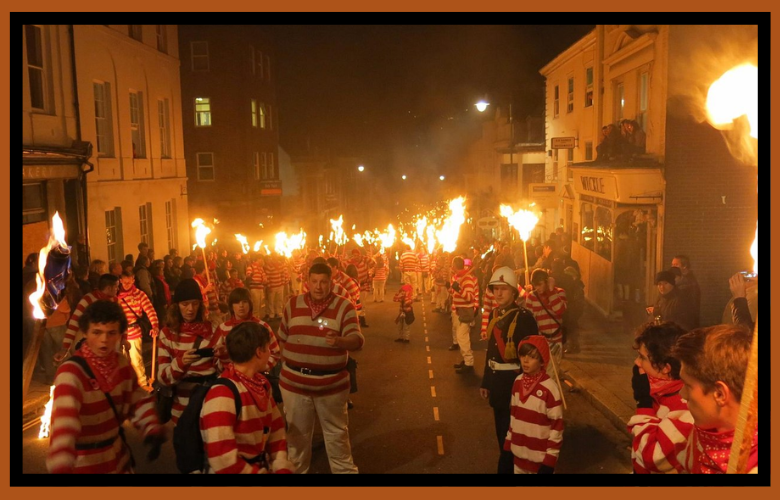
The Lewes Bonfire is among the most renowned and unique Bonfire Night celebrations that takes place annually in the old town of Lewes in East Sussex. As opposed to a regular fireworks spectacle, the festival features such elements as torch-lit processions, bonfire societies, burning crosses, fireworks, music, costumes, and effigies. Moreover, its origins are associated with the Gunpowder Plot and the memory of the 17 martyrs of Lewes, thus giving the festival an extra historical value. What is more, it has some politically and religiously controversial symbolism, with the figure of Pope Paul V as the central element. Having the Lewes 2026 scheduled for 5 November, the attention towards its history, parade, effigies, tickets, safety measures and controversy is increasing.
Lewes Bonfire History and the Origins of the Tradition
The wider history of Bonfire Night dates back to the Gunpowder Plot of 1605. Guy Fawkes and his fellow conspirators attempted to destroy Parliament and kill King James I, but the plan was discovered before it could succeed. Over time, 5 November became associated with public gatherings, bonfires and later fireworks. Lewes developed its own version of the tradition, with local customs becoming increasingly organised during the nineteenth century.
The town has another important historical connection through the 17 Protestant martyrs who were executed in Lewes during the Marian persecutions. Their deaths became an important part of local remembrance, and burning crosses are carried during the procession in connection with their memory. This gives the event a much more complicated historical background than a simple celebration of Guy Fawkes. National political history and local religious history have become intertwined over generations.
The development of individual bonfire societies helped create the modern structure. Different groups established their own identities, costumes, symbols, processions and firesites. Some traditions have remained recognisable, while others have changed in response to social attitudes. This is why the celebration is best understood as living heritage rather than a historical re-enactment. Each generation has inherited the tradition while also contributing something new to it.
Lewes Bonfire Procession and What Happens on the Night
The Lewes Bonfire procession is one of the most recognisable parts of the celebration. Participants move through the historic streets carrying flaming torches, banners and traditional symbols. Marching groups, drums, costumes and fire create an intense atmosphere that is very different from a normal family fireworks display. The processions also include historical elements, including burning crosses connected with the Lewes Martyrs.
There is not one simple procession covering every activity. Different societies maintain their own traditions before the evening progresses towards separate firesites. Large bonfires and fireworks form the climax later in the night. The different locations and arrangements are part of what makes the event distinctive, but they also make it difficult for an outsider to understand without researching the individual societies and current local arrangements.
The main features people associate with the evening include:
- Torchlit processions through historic streets
- Marching groups, drums and traditional costumes
- Burning crosses connected with the Lewes Martyrs
- Large bonfires at separate firesites
- Firework displays later in the evening
- Political and topical effigies
- Historical symbols and society traditions
- Significant road and transport restrictions
The physical conditions are an important part of understanding the event. Historic streets can become extremely crowded, while flames, fireworks, smoke and loud firecrackers create an environment unlike an ordinary public display. Current local guidance warns that non-residents should not travel into Lewes simply to watch the event. People who have a legitimate reason to attend should follow instructions from stewards, emergency services and local authorities.
Effigies, Pope Paul V and the Controversy
The tradition of Lewes Bonfire effigies is one of the biggest reasons the event receives national attention. Effigies can represent political figures, celebrities, historical personalities or controversial subjects. Modern choices can change from year to year, so there is no guaranteed permanent Lewes effigies list for 2026. The use of topical figures allows societies to express satire and comment on people or events that have attracted public attention.
The most famous historical figure is Pope Paul V, which explains the continuing interest in the Lewes Pope tradition. Paul V was pope during the period of the Gunpowder Plot, and his image became associated with anti-Catholic traditions that developed around the celebration. However, historical context is important because Paul V did not organise the Gunpowder Plot. His presence in the tradition therefore reflects the way different historical events became connected over time.
This has created a continuing Lewes Bonfire controversy. Supporters may regard the imagery as inherited historical symbolism, while critics argue that burning a religious figure is inappropriate in modern Britain. Other historical costumes and displays have also attracted criticism, particularly where modern audiences have considered them racist or offensive. Some practices have subsequently changed, showing that the tradition is capable of adapting while retaining its broader community identity.
Lewes Bonfire Tickets, 2026 Access and Safety
People searching for Lewes tickets should remember that admission normally relates to individual firesites rather than giving unrestricted access to the entire town. Different societies can have different arrangements, including ticketed entry, free access or collection-based admission. Prices and availability can change, so anyone with a legitimate reason to attend should check current information before making travel arrangements.
Access to Lewes is another major consideration. Road closures are introduced because of the size of the celebration, while normal rail and road arrangements can be affected. Parking in the town centre is extremely restricted, and visitors cannot assume that they will be able to arrive or leave whenever they choose. Planning based on an ordinary day in Lewes can therefore result in serious problems on 5 November.
Safety should also be considered carefully. Flaming torches, fireworks, smoke, firecrackers and large crowds create risks that do not normally exist at a standard fireworks display. Steep streets and dense crowds can make movement difficult for people with mobility issues, while young children may find the noise overwhelming. For people who are not local residents, watching authorised coverage remotely may be a much more practical way to experience the spectacle.
Why Do People Choose It and Is It Worth Attending?
One of the strongest reasons people value the celebration is its community character. Society members spend months preparing for the event, from making torches and costumes to constructing tableaux and organising fundraising activities. The procession is therefore the result of significant work carried out throughout the year. This gives participants a sense of ownership and involvement that is difficult to reproduce at a commercial fireworks display.
The historical value is another reason for its continuing popularity. The celebration brings together the Gunpowder Plot, the Lewes Martyrs, Victorian bonfire traditions and modern political satire. Even the controversial aspects can be viewed as evidence of how traditions change and how communities debate inherited customs. Rather than having one simple meaning, the event contains several layers that different participants and observers may interpret differently.
Whether it is worth attending depends on the individual. For local residents, society members and people with a genuine connection to Lewes, the experience can be deeply meaningful. For tourists who simply want to watch fireworks, it may not be worth the difficulty. Current local guidance discourages non-residents from travelling into the town to spectate, so remote viewing is a sensible alternative for most outsiders. Visiting Lewes at another time of year can also provide a better opportunity to explore its history without the extreme crowds.
- Also Read. Patrick Christys Wife Who Is Emily Carver?
Frequently Asked Questions
When is Lewes Bonfire 2026?
The 2026 event takes place on Thursday 5 November 2026. Processions traditionally begin during the early evening, followed by fireside activities and fireworks later in the evening.
What is the history behind the celebration?
The tradition is connected with the 1605 Gunpowder Plot and the 17 Protestant martyrs executed in Lewes during the Marian persecutions. These historical events became important parts of local Bonfire traditions.
What is the Pope Paul V controversy?
Pope Paul V became associated with anti-Catholic symbolism within the tradition. Supporters view the imagery as historical heritage, while critics argue that burning a religious figure is inappropriate in modern society.
What are the famous bonfire effigies?
Effigies can represent political figures, celebrities, historical personalities or controversial subjects. The exact figures can change each year, so visitors should not assume that previous years’ displays will be repeated.
Are tickets required?
Some firesites may require admission tickets, while others can offer free entry or collection-based access. Arrangements vary between individual societies, so current information should be checked before attending.
Conclusion
Lewes Bonfire is one of the most unique and exciting Bonfire Nights celebrated in Britain, as it encompasses history, community, parade, fireworks and controversy. In addition, the link between the Gunpowder Plot and 17 martyrs of Lewes adds a layer of history to the celebration. The unique local traditions are kept alive by bonfire societies, as well as the pope Paul V tradition and contemporary effigies, which make the event a topic of debate. As for the 2026 celebration, everyone wishing to visit will have to be informed about ticket prices, transport, road closures and safety restrictions in advance. For the residents of Lewes, the event will be an important part of community heritage. For the visitors, it will be even more interesting, knowing the history and traditions behind it.
